Medical image segmentation
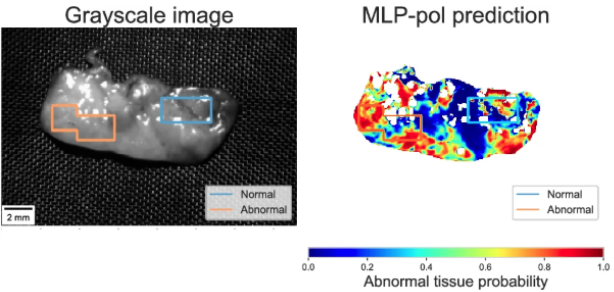
As part of my PhD in Biomedical Engineering, I’m developing a novel AI-driven system to assist in the detection of pancreatic cancer from ex-vivo biopsy samples. This system supports surgeons during pancreatic resection by ensuring clean surgical margins, helping reduce recurrence and improve patient outcomes.
The system combines state-of-the-art deep learning models with advanced optical imaging techniques — bringing together tools like Meta’s Segment Anything, UNet, and GradCAM to form a robust and explainable pipeline. It’s a practical example of how modern AI can be applied to solve critical challenges in biomedical imaging.
A paper detailing part of this work — including our UNet-based segmentation pipeline, CNN classification with post-processing, and tissue isolation using SAM — has been accepted for presentation at the SPIE Optics + Photonics 2025 conference. The publication and companion poster will be shared here once released in August.
🧩 Features
- 🌈 Input from multi-spectral Mueller Matrix polarimetry
- 🧠 UNet for pixel-wise tissue segmentation
- 🔬 CNN-based tissue classifier with domain-specific post-processing
- ✂️ Segment Anything Model (SAM) for tissue isolation and background removal
- 💡 GradCAM visualizations for explainability and pathologist trust
- 🧪 Integration with physical biopsy imaging workflow
💡 Technologies Used
- PyTorch Lightning – Model training and experimentation
- UNet / ResNet-based CNN – Core deep learning architectures
- GradCAM – Model explainability for classification outputs
- Meta Segment Anything (SAM) – Pre-segmentation for background removal and tissue isolation
- OpenCV / scikit-image – Polarimetric image preprocessing
- NumPy / Pandas / Matplotlib – Data manipulation and visualization
- Python – End-to-end pipeline development
🌐 Demo
🌐 Resources
👉 Nature Scientific Reports (MLP Classifier) 👉 SPIE - Applications of Machine Learning 2025 (UNet multitask segmentation and classification) 👉 I’ll update this list as new papers are released (exp: November/December 2025)